

Genes introgressed from wild relatives often confer superior disease resistance compared with those in modern cultivars. Although domesticated crops share a wild ancestry, selective breeding and shifting pathogen pressures have eroded their natural defence repertoire. Consequently, modern crop improvement increasingly seeks to reintroduce these ancestral mechanisms to restore durable, broad-spectrum immunity in elite varieties.
Introgression is a keystone of genetic improvement, built on the assumption that a single gene acts like an absolute command, dictates a precise trait, and behaves predictably. However, nature frequently disrupts this predictability. Imagine giving the same script to two actors: one turns it into comedy, the other into drama. When identical introgressions encounter different genetic backgrounds, the resulting expression can appear entirely different. Even within the same species, distinct genotypes can respond to the same introgressed gene in markedly different ways or even suppress its expression. This phenotypic variation underscores a key principle in modern genetics: genes do not function in isolation, and host background genetics strongly influences their expression. The entire DNA sequence and allelic composition of a plant provide the structural basis for how specific traits are expressed, inherited, and interact with different environments. Although plant breeders actively manipulate genetic backgrounds through systematic approaches such as backcrossing, marker-assisted selection, and foreground vs. background selection, the mechanistic understanding of this process remains unclear. Two studies (Zeng et al. 2020, Lin et al. 2026) that engineer bacterial blight resistance and uncover the mechanistic pathway of rice bacterial blight resistance provide insights into host genotype variation in resistance gene expression.
Traditionally, plants rely on disease-resistance genes to fight infections. Inactivating susceptibility genes, which encode functions actively exploited by fungal, bacterial, and viral pathogens, can yield novel disease-resistant crops. Zeng et al. (2020) demonstrated that CRISPR knockout of the susceptibility gene SWEET14 (Sugars Will Eventually be Exported Transporter 14), Xa41(t)] in mutants (CR-S14) of the rice cultivar Zhonghua 11 (Oryza sativa subspecies japonica) provided broad-spectrum resistance to both Asian and African Xanthomonas oryzae pv. oryzae (Xoo) strains of the bacterial blight pathogen, with enhanced plant height (~8% taller) without affecting yield. A parallel knockout mutant of the same gene at the same target site in the japonica model rice Kitaake remained susceptible to African Xoo strains, whereas the double knockout [(sweet13 (xa25); sweet14 (xa41(t))] in the Kitaake background conferred complete resistance to African strains, suggesting that gene knockout(s) can yield different resistance outcomes depending on the genetic background of rice cultivars. The authors note that the African Xoo strains may activate other susceptible genes in Kitaake but not in Zhonghua 11, resulting in Kitaake’s susceptibility even when only OsSWEET14 [Xa41(t)] is knocked out, as at least one SWEET gene is required for Xoo virulence.
In a recent Nature study led by Chinese scientists, Lin et al. (2026) set out to reconstruct the wild-rice trait of bacterial blight resistance in modern cultivars, aiming for stable, broad-spectrum protection. The study showed that both pattern-triggered immunity (PTI; basal resistance) and effector-triggered immunity (ETI; gene-for-gene resistance) operate in novel rice germplasm/line generated. It also demonstrated that the genetic background of domesticated rice lines shapes the expression of resistance genes. The authors clarified the immune network surrounding the newly identified resistance gene Xa48 and, for the first time, revealed the molecular mechanism underlying the phenotypic expression of two stacked resistance genes, Xa48 and Xa21, which confer bacterial blight resistance. This highlights the need for compatibility between the defence pathways governed by these genes to achieve the cumulative impact. This work has attracted considerable scientific interest (Chen et al. 2026, Hu et al. 2026, Su et al. 2026). The novel race-specific resistance gene Xa48, located on chromosome 11, was identified in the classic indica rice cultivar Shuangkezao, a descendant of Oryza rufipogon (AA genome), the wild ancestor of cultivated rice, including both indica and japonica subspecies. It was discovered through extensive germplasm screening for bacterial blight resistance, using map-based cloning and genome-wide association analysis (GWAS). Xa48 is a major rice bacterial blight resistance gene that encodes a nucleotide-binding leucine-rich repeat (NLR) receptor protein. It provides lifelong, broad-spectrum immunity against many Xoo strains, especially those common in rice-growing regions of Northeast and Southeast Asia. An earlier Indian study (Sinha et al. 2023) identified Xa48(t) through targeted map-based cloning in a wide-hybridisation line derived from O. officinalis (CC genome). Both studies agree on the chromosomal location, although final functional validation of Xa48(t), through knockout or complementation, remains pending. During wide hybridisation, a small chromosomal segment from a wild relative is introgressed into the cultivated rice genome. The identity of Xa48 therefore highlights the complexity of wide-hybridisation lines. Nevertheless, in indica lines carrying Xa48(t), the observed resistance suggests that the broad-spectrum functional allele either shares the same sequence as Xa48 or represents an orthologue derived from O. rufipogon. Combining allele sequence comparisons with pathotype profiling remains the gold standard for understanding how plant immune systems evolve and function.
Building on this resistance framework, Lin et al. (2026) identified the pathogen signal that activates XA48. By screening a large mutant library of an avirulent Xoo strain, they isolated avrXa48, which encodes the ancient type III-secreted effector XopG (Xanthomonas OUTER PROTEIN G). XopG is a metallopeptidase and virulence factor secreted by Xoo. Disrupting this effector caused the pathogen to lose avirulence, whereas introducing it into the highly virulent strain PXO99A made that strain avirulent on Xa48 rice. These results demonstrated that XopG is the molecule recognised by XA48 in a lock-and-key manner, triggering effector-triggered immunity without a yield penalty. Mechanistically, XopG does not cleave XA48 in vivo; instead, it promotes XA48 oligomerisation, consistent with resistosome assembly within the XA48-XopG complex and the formation of a calcium-permeable cation channel that drives Ca2+ influx into the cytosol.
Lin et al. (2026) also identified two highly conserved paralogous transcription factors in rice, OsVOZ1 (Oryza sativa VASCULAR PLANT ONE-ZINC FINGER 1) and OsVOZ2, which likely arose from an ancient duplication event. These factors normally suppress immunity while helping to balance defence with abiotic stress adaptation, including cold tolerance. In indica rice infected by an Xoo strain lacking the xopG effector gene, OsVOZ1/2 remain intact and continue to dampen pattern-triggered immunity (PTI; Fig. 1a). Thus, even when a PAMP such as flagellin is recognised by a cell-surface pattern-recognition receptor and initiates basal PTI, OsVOZ1/2 maintain an energetic brake that prevents full-scale immune activation.
During infection by a strain carrying xopG, the interaction shifts from transcriptional control to protein-level immune activation. XA48 detects the ancient non-TAL effector XopG, delivered into the cytoplasm through the Xoo type III secretion system. XopG then exploits host protein networks to promote degradation of OsVOZ1 and OsVOZ2 through the ubiquitin-proteasome system, removing the immune brakes and rapidly activating effector-triggered immunity (ETI; Fig. 1b). This protein-degradation mechanism explains the speed and strength of the response, distinguishing it from a slower transcriptional switch. The XA48 receptor, a coiled-coil nucleotide-binding leucine-rich repeat protein, confers broad-spectrum bacterial blight resistance in seedlings and adult plants and complements the resistance spectrum of Xa21. Its absence from japonica cultivars reflects asymmetric subspecies selection: analysis of Xa48 alleles across the 3K rice germplasm and Xoo inoculation responses indicates functional retention in O. sativa subspecies indica but loss in O. sativa subspecies japonica.
The outcome therefore depends strongly on genetic background. In indica, OsVOZ1/2 alleles are compatible with functional Xa48, allowing XA48 to remove the repressor proteins during infection without disrupting reproductive development; immunity and high grain yield can coexist. In japonica, however, Xa48 has been pseudogenised and is non-functional. Consequently, when Xoo delivers XopG into the cytoplasm, the missing XA48 recognition module cannot trigger ETI, and both PTI restraint and ETI failure leave immunity blocked (Fig. 1c).
This contrast is sharpened by the evolutionary histories of the two rice subspecies. In the indica lineage, evolution has preserved a broader OsVOZ1 haplotype toolkit, including OsVOZ1A (alanine) and OsVOZ1S
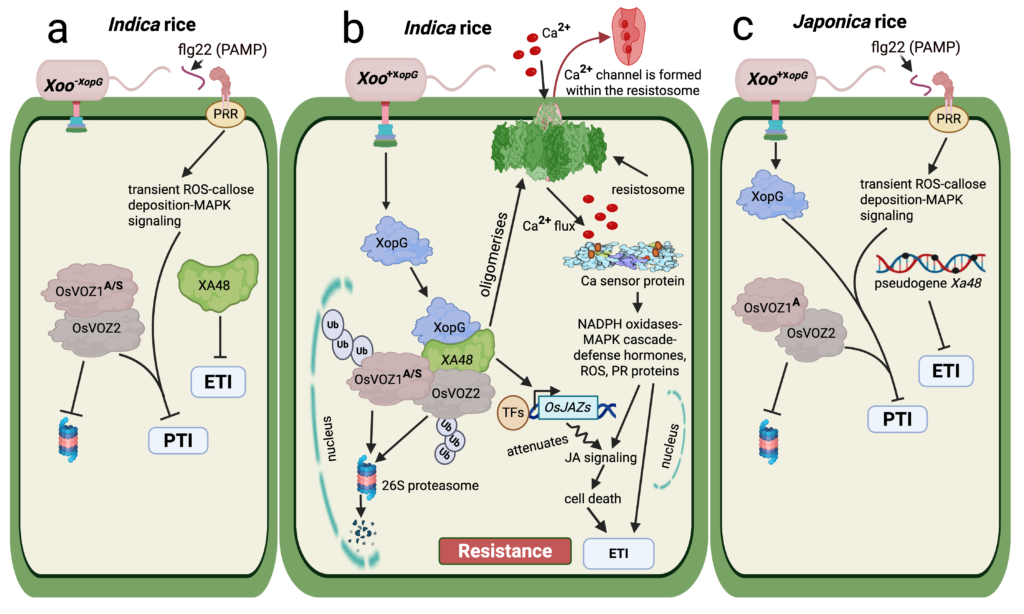
Fig. 1. Working model of Xa48-mediated bacterial blight resistance in Oryza sativa subspecies indica and japonica. (a) In indica rice infected with Xanthomonas oryzae pv. oryzae (Xoo) lacking the cognate effector gene xopG (Xanthomonas outer protein G), the OsVOZ1A/S–OsVOZ2 transcription-factor heterodimer remains stable and represses pattern-triggered immunity (PTI). Because XopG is absent, XA48 is not activated, and effector-triggered immunity (ETI) is not induced. (b) In indica rice infected with Xoo carrying xopG, XopG interacts with XA48 and the OsVOZ1A/S–OsVOZ2 complex. The XA48–XopG complex promotes degradation of OsVOZ1 and OsVOZ2 via the ubiquitin–proteasome system, relieving immune repression. XopG-induced XA48 oligomerisation forms a cell-periphery resistosome with a Ca2+-permeable channel that drives Ca2+ influx into the cytoplasm. The XA48–XopG complex also attenuates jasmonic acid (JA) signalling by downregulating OsJAZ genes, a process modulated by transcription factors such as MYC2 (myelocytomatosis), thereby promoting cell death. Together, ETI and Ca2+ signalling reinforce resistance to Xoo. (c) In japonica rice infected with Xoo carrying xopG, the loss-of-function Xa48 pseudogene prevents formation of the functional XA48–XopG complex. As a result, the OsVOZ1A–OsVOZ2 heterodimer remains stable, PTI remains repressed, and ETI is not activated. (Image created with Biorender.com)
(serine), both of which are compatible with XA48 (Fig. 1a,b). In the japonica lineage, domestication and artificial selection took a different route: genetic variation narrowed, OsVOZ1S was lost, and only the
OsVOZ1A haplotype remained (Fig. 2a). This background creates immune incompatibility when functional Xa48 is introgressed into modern japonica: the interaction between XA48 and the japonica OsVOZ1A background becomes hyperreactive, triggering low-level autoimmunity or hybrid incompatibility that reduces seed setting and grain yield. Thus, the same Xa48 allele can confer robust resistance in one background but impose a reproductive penalty in another, showing that resistance genes must be evaluated alongside the host allele networks that determine their compatibility.
This XA48–OsVOZ1 module also helps explain why resistance does not transfer uniformly across rice backgrounds. XA48 localises to both the cell periphery and the nucleus, positioning it to connect pathogen recognition with downstream immune regulation. In a compatible background, this module strengthens bacterial blight resistance without compromising agronomic performance; in an incompatible one, the same interaction can become maladaptive. The case therefore represents host regulatory epistasis: the effect of a primary resistance locus depends on the allelic state of a downstream transcription-factor node. Defining that node transforms the vague idea of a “background effect” into a testable molecular interaction that breeders can manage when designing durable resistance combinations.
Rather than relying on a single off-switch, Xa48-mediated ETI uses sustained Ca2+ influx as a second messenger to trigger a two-pronged defence when Ca2+ binds to its receptors: an NADPH oxidase-driven engine that fuels both the reactive oxygen species (ROS) burst and hormonal tuning [jasmonic acid (JA)/salicylic acid (SA) balance], and a mitogen-activated protein kinase (MAPK)-pathogenesis-related (PR) protein axis. Together, these pathways converge on specific cysteine proteinases, leading to vacuolar processing enzyme (VPE)-mediated collapse of the vacuole, which seals Xanthomonas in a localised necrotic tomb formed by hypersensitive cell death before it can exploit the host tissue.
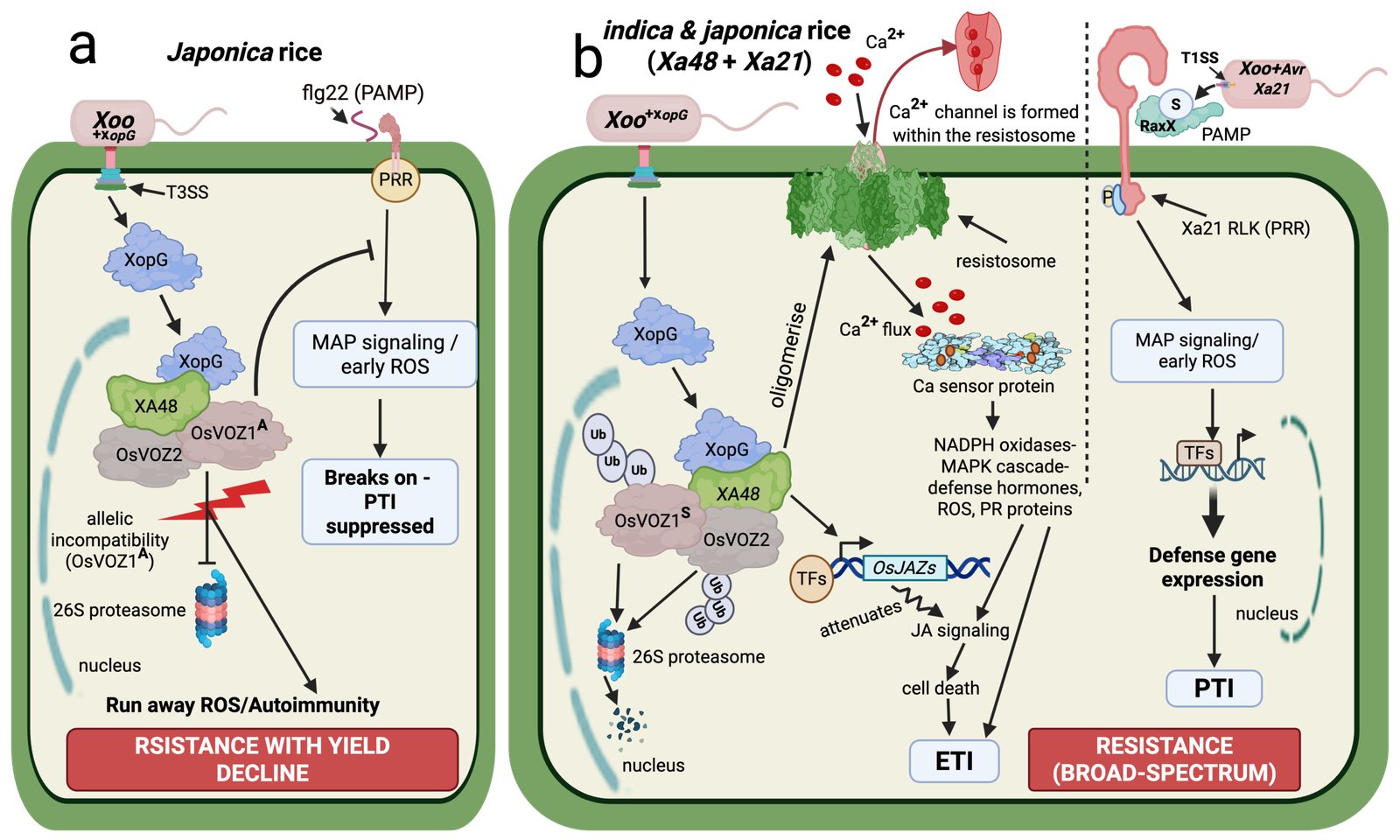
Fig. 2. Working model of Xa48-mediated bacterial blight resistance in japonica rice Nipponbare (NIPB) introgressed with the Xa48 resistance gene from indica rice (BG139), and in a de novo-developed Oryza sativa ssp. japonica line expressing the XA48–OsVOZ1S immune module. (a) When japonica rice cv. NIPB carrying Xa48 is infected with an Xoo strain carrying the effector gene xopG (Xanthomonas outer protein G), the XA48–XopG complex targets the OsVOZ1A–OsVOZ2 heterodimer. A non-functional or hyper-reactive mismatch between XA48 and the OsVOZ1A–OsVOZ2 complex causes allelic incompatibility, represented by the red lightning bolt, blocks the ubiquitination machinery, and results in autoimmunity, resistance expression, and yield decline. (b) In japonica TP309, generated by a transgenic approach; indica Shuangkezao, generated by cross-breeding; and a de novo-developed japonica NIPB background in which the deleterious OsVOZ1A is replaced by the compatible OsVOZ1S haplotype, lines carrying stacked Xa48 and Xa21 activate both PTI and ETI after infection with an Xoo strain carrying xopG. This reconstructed immune module confers broad-spectrum resistance to bacterial blight without a yield penalty. (Image created with BioRender.com)
The divergence of indica and japonica, the two major subspecies of O. sativa, from their wild ancestor Oryza rufipogon was not a single, uniform domestication event, but a layered evolutionary process shaped by geography, ecology, and human selection. Long before domestication, geographically separated populations of O. rufipogon had already adapted to different climates and habitats across Asia, creating deep genetic structure within the wild gene pool. From this structured ancestry, japonica was likely domesticated mainly from perennial O. rufipogon populations in temperate regions, particularly around the Yangtze River basin of southern China, whereas indica arose from distinct annual or perennial lineages adapted to tropical and subtropical regions of South and Southeast Asia. Thus, the contrasting genetic backgrounds of indica and japonica reflect both natural divergence in wild rice and subsequent, partly independent domestication histories.
Lin et al. (2026) further showed that asymmetric selection of Xa48 reflects both host ecology and pathogen adaptation. In disease-prone, typhoon-affected tropical and subtropical rice-growing regions, strong bacterial blight pressure likely favoured the retention of functional Xa48 in indica backgrounds. By contrast, in japonica, selection for high yield and reproductive performance appears to have outweighed the benefit of retaining Xa48, leading to its loss. Meanwhile, alongside this genetic divide, the pathogen evolved in parallel: where Xa48 was retained, in indica-growing regions, many Xoo populations accumulated loss-of-function mutations in the XopG effector to evade XA48-mediated recognition, whereas in japonica-growing regions, where the host molecular trap was absent, functional XopG could be preserved as a virulence factor to colonise the plant without fear of triggering an immune explosion. Thus, the Xa48 story illustrates how environmental disease pressure, yield-oriented domestication, and pathogen counter-adaptation together shaped distinct indica and japonica genetic backgrounds.
The OsVOZ1/2 factors therefore act less like simple on–off switches than context-dependent immune regulators. In bacterial blight, their degradation enables XA48-mediated ETI, whereas their basal repressive role helps prevent unnecessary defence activation under normal growth conditions. This duality creates the apparent paradox: the same regulatory proteins that restrain PTI can, depending on the receptor and pathogen context, become essential components of a resistance response.
Evidence from the rice blast-resistance NLR gene Piz-t in Nipponbare further illustrates this context dependence (Wang et al. 2021). The japonica OsVOZ1A allele is not inherently defective; it can support blast resistance without an apparent yield cost. The problem arises when a particular OsVOZ1 haplotype is paired with an incompatible NLR module, such as Xa48 in a japonica background. Thus, breeders cannot treat resistance genes as universally portable units. Each candidate gene must be assessed within the recipient allele network that will determine whether immunity is strengthened, suppressed, or redirected at an agronomic cost.
Evolution-aware breeding can use these insights to reconstruct compatible resistance modules rather than simply transfer individual genes. Lin et al. (2026) applied this principle by rebuilding Xa21–Xa48 resistance in modern rice cultivars through marker-assisted introgression, targeted allele replacement, and immune-module reconstruction across contrasting backgrounds. In indica Shuangkezao, stacking Xa48 with Xa21 combined ETI and PTI layers of bacterial blight defence. In japonica Nipponbare, where Xa48 introgression was constrained by incompatibility, the authors replaced the deleterious OsVOZ1A context with the compatible OsVOZ1S haplotype while introducing Xa48 and Xa21. This rebuilt both immune layers and restored broad-spectrum bacterial blight resistance without the yield penalty previously associated with the japonica background (Fig. 2b). The study therefore moves gene stacking beyond a simple additive model: durable resistance depends not only on combining complementary resistance genes, but also on rebuilding the regulatory background that allows them to act together without agronomic cost.
Historically, when a transferred resistance gene failed in a new variety, breeders often attributed the result to an undefined “genetic background effect” or to modifier genes. The SWEET and Xa48 examples show that this effect is not vague genomic noise; it reflects specific host–pathogen and host–allele interactions that differ among pathosystems. By deciphering the host regulatory epistasis of the XA48–OsVOZ1 module, we begin to overcome these fundamental breeding constraints—validating the insight of Ortiz-Barrientos et al. (2026) that “when epistatic effects shape fitness, constraints could hide substantial genetic potential behind these boundaries.” Moving forward, resistance breeding must evolve from simply transferring useful individual loci to designing compatible gene–background combinations that unlock this hidden potential while preserving both immunity and crop yield.
References
Chen X, Xiao S, Dong H. 2026. The XA48–OsVOZ1 immune module: from asymmetric domestication to PTI–ETI pyramiding for yield‑penalty‑free resistance. Phytopathol Res 8:59.
Hu C, Ning Y, Li, Wang. G-L. 2026. An NLR-TF immune module under asymmetric selection shapes rice immunity and yield. Mol Plant 19:1147-1149.
Lin H, Chen F, Cheng G, Yan B, Yuan M, Qiu J, Lu Y, Suo M, Chen Y, Wang Y, Cui K, Gong X, Liu S, Liu B, Liu J, Wang J, Li R, Mao B, Xu J, Jeon J-S, Huang X, Han B, Yang D-L, Gao Q, Xu H, Deng Y, Chen G, He Z. 2026. Asymmetric selection of a rice immune module and rebuild of disease resistance. Nature 653:840-849
Ortiz-Barrientos D, Jordan D, Cooper M. 2026. The hidden geometry of breeding constraints. Nat Plants 12:1316–1324.
Sinha P, Kumar D, Hajira Sk, Solanki M, Gokulan CG, Das A, Miriyala A, Gonuguntala R Elumalai P, Kousik MBVN, Masthani SK, Chaitra K, Yugander A, Laha GS, Chirravuri NN, Patel HK, Ghazi IA, Kim S-R, Jena KK, Hanumanth SR, Oliva R, Mangrauthia SK, Sundaram RM. 2023. Fine mapping and sequence analysis reveal a promising candidate gene encoding a novel NB-ARC domain derived from wild rice (Oryza officinalis) that confers bacterial blight resistance. Front. Plant Sci 14:1173063.
Su Y, Zang S, Sun T, You C, Que Y. 2026. An NLR‑VOZ seesaw: from asymmetric selection to synthetic broad‑spectrum resistance. Stress Biol 6:52.
Wang, J, Wang R, Fang R, Zhang C, Zhang F, Hao Z, You X, Shi X, Park CH, Hua K, He F, Bellizi M, Vo KTX, Jeon J-S, Ning Y, Wang G-L 2021. Two VOZ transcription factors link an E3 ligase and an NLR immune receptor to modulate immunity in rice. Mol Plant 14:253–266.
Zeng X, Luo Y, Vu NTQ, Shen S, Xia K, Zhang M. 2020. CRISPR/Cas9-mediated mutation of OsSWEET14 in rice cv. Zhonghua11 confers resistance to Xanthomonas oryzae pv. oryzae without yield penalty. BMC Plant Biol 20:313.
Acknowledgements: Interactions with Google Gemini for drafting this blog and with MS Copilot for editing are acknowledged.
Suggested citation:
Sridhar R. (2026, August 16). Background matters: Why identical introgressions yield unidentical traits.
sridharr.com/background-matters-:-why-identical-introgressions-yield-unidentical-traits
DOI: 10.13140/RG.2.2.10385.39520.